

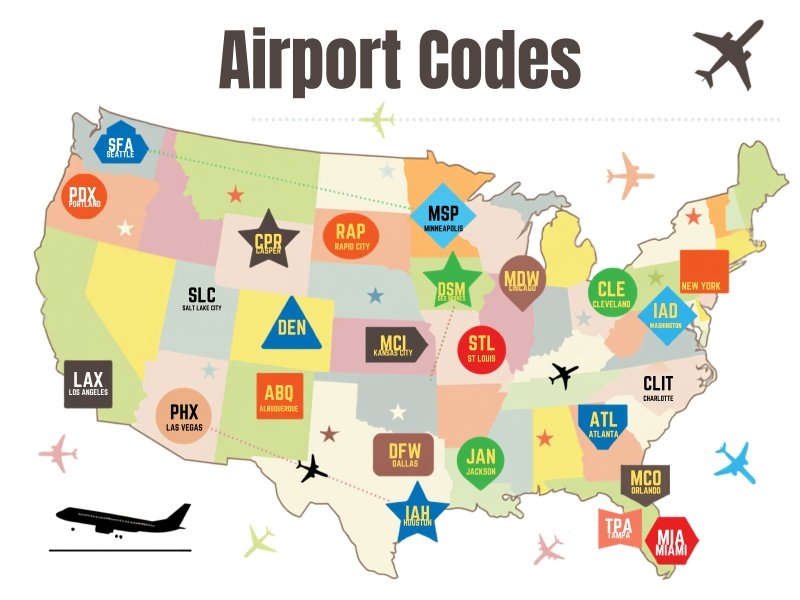
Airport codes aid air travelers; by using codes, people don't have to remember full airport names.
The codes are often on tickets and on baggage labels, in searches for flights, on airport signage, on flight trackers, and on countless other forms of flight information.
These are defined as "a combination of letters or numbers that identify a particular airport or other facility (e.g., radio stations) involved in civil aviation, aviation services, etc." The identification purpose is to provide standardized ways to communicate, search, track flights, and arrange reservations.
The three main types are IATA airport codes, ICAO airport codes, and FAA LID airport codes. IATA provides general travel-related airport identifiers, ICAO provides air transport operations identifiers, and FAA LIDs provide facility- and aircraft-related location identifiers.
It's a three-letter code set by the International Air Transport Association (IATA), and travelers will commonly encounter these in terms of booking tickets and boarding passes or seeing them labeled on baggage and on scheduled flight information. They are used so widely across airlines that most air travelers have become familiar with the process.
Examples: JFK is the IATA code for John F. Kennedy International Airport. LAX for Los Angeles International Airport.
Some codes might still correlate to older names for an airport; for various other reasons, there may be other airport codes for the same airport.
Its meaning is the International Civil Aviation Organization airport code. The codes have four letters, as they aid in the way that Pilots, air traffic controllers, dispatchers, and others related to professional flying operations interact and operate their craft through planned flights or for a range of other communication or navigation tasks.
Some ICAO codes are formed using geographical rules, helping the navigator find regions or points of reference within the airways.
Examples: The ICAO airport code for JFK is KJFK. ICAO airport codes are almost always professional in function instead of passenger-related, like IATA airport codes, although their primary identifier uses a combination of letters used in IATA.
Explore This One: Red Eye Flight Tips for a Better Overnight Journey
FAA LID stands for Federal Aviation Administration Location Identifier. FAA LID airport codes may have a series of numbers mixed with letter identification to denote the local air facilities.
Small airports that don't possess a 3-letter IATA code sometimes have an FAA identifier.
Generally, there might be similarity, but an FAA LID isn't the same as an IATA code, even if the main letters appear the same with the additional numbers and letters.
What is an IATA airport code, an ICAO airport code, and an FAA LID? IATA is for the commercial traveler; ICAO is for those performing professional aviation and flying. FAA LIDs are for facilities and aircraft. Any airport may belong to more than one code system.
For example, there are multiple codes for JFK, with KJFK being its four-digit ICAO counterpart, with its four-letter identifier, the first letter specifying the continent for the airport code.
The history of airport codes goes way back. As aviation grew, there was a definite need for aviation staff to identify aviation locations quickly. First, they used plain English, but after some time and further progression, aviation radio operators utilized certain letter combinations in response to specific signal types.
This also proved quicker than plain text for communication. Three-letter identifiers were introduced widely, while even later a four-letter ICAO specification arrived to help manage world aviation operations.
The history has resulted in some peculiar-looking flight codes; some were used for former airports of current ones, others referred to military identifiers, some codes were just words/nicknames given as an identifier, and others may still pertain to an old airport/airbase code and have not changed.
You already probably know how to identify airport codes without even realizing it, but when an airport could have different code identities, this gets trickier.
The airport codes list is everywhere in traveler and passenger information; for example, some popular international identifiers:
There is often an ICAO code that matches each airport; for example, the ICAO airport code for JFK is KJFK, and LAX has KLAX.
It's important not to mix IATA Airport Codes with ICAO Airport Codes, both for passenger travel for IATA Airport Codes and professional operations for ICAO Airport Codes.
It can reduce communication confusion and aid in international travel by offering a consistent way for identifying countries, states, provinces, cities, and individual airports as well.
The need for international airport code names arose as air transportation grew to a global scale and standardized systems for identifying locations were needed on a scale that hadn't occurred previously.
It's hard to communicate or find something in the air with just English; these codes allow for communication in a coded fashion, which ultimately is much faster. The main purpose of having an airport code system for an airport is to ensure the quickest means of transport identification for both domestic and international purposes to be organized.
These codes are present throughout the reservation systems, luggage handling procedures, and in the scheduling information that travels through airline information systems.
Learn More: Airport Security Wait Times: Quick Tips for Faster TSA Line
An airport code identifies specific air traffic destinations; they provide a basis for travel organization and communication for a global range of systems. There are IATA codes used by many commercial travelers, ICAO codes used for international operation of aviation flights and air traffic, and local FAA LID airport codes used for local identification of aircraft, airports, and navigation systems.
Being accustomed to one or a variety of airport code types will aid the air traveler in understanding the difference.
Yes, airports may change their IATA or other airport codes when a name change or administrative decision occurs, or due to operational alterations and other events. Nevertheless, airport codes tend to stay in place for many decades because altering historic identifiers requires complicated adjustments in existing air traffic systems and traveler data.
Not necessarily. Many smaller airports without regular scheduled air service may not possess an IATA code, although they may be recognized with an ICAO airport code or FAA LID airport code for other aviation and logistical reasons.
Yes, an airport can have an IATA code, an ICAO airport code, and an FAA LID airport code (although LIDs are only used in the US). Some airport identifiers might even be the same or appear similar for the purposes of each identifier system, based on the particular rules that each one follows.
Yes. IATA airport codes are displayed on most luggage tags to tell handlers where to take the baggage, and these labels help ground personnel route the baggage efficiently as it’s transferred between one airport and another.
Short codes are more convenient to say, read, write, print, display, store, and process. Short airport codes take up less space on booking tickets, luggage tags, flight schedules, and airport departure/arrival boards.
This content was created by AI